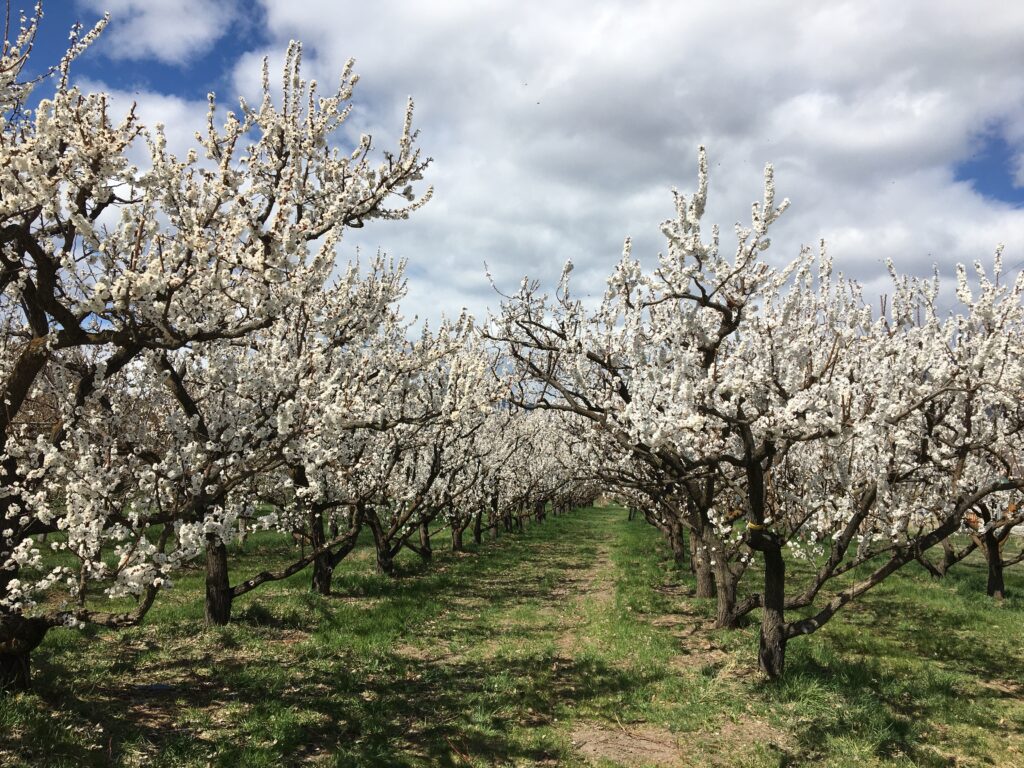
An important part of future-proofing our community against the extremes on our horizon is in strengthening our local food security. We are so fortunate that Kelowna remains home to many dedicated fruit & vegetable growers, and while it may be our many acclaimed vintners who steal the spotlight with award-winning VQA wines, I want to give attention to the underrecognized farms whom we owe the world class cherries, peaches, nectarines, apricots, plums, apples, pears, tomatoes et al that keep our farmers’ markets richly festooned and are a tourist attraction in and of themselves.
But the sudden demise of the B.C. Tree Fruits Co-operative in July 2024 put hundreds of our local growers in a tight spot. A trusted partner of this magnitude ceasing operations overnight put our growers in a crisis of having to independently plot out new distribution channels and logistics to get their season’s crops packed and sold. While private packing facilities across the Okanagan have been able to largely pick up the slack, the absence of central co-operative packinghouses at the scale of B.C. Tree Fruits is still very much felt.
The exact mix of causes driving the declaration of bankruptcy are still disputed, but low fruit volumes from a devastating February cold snap are a major confounding factor recognized in the disastrous shortfall at B.C. Tree Fruits. This illustrates the serious vulnerability to extreme weather that our agricultural industries face. We are living in an age of destabilizing growing conditions that demands an incredible amount of foresight to navigate, where even decades-established organizations can go insolvent in a blink. How many bad seasons back-to-back can any grower be expected to survive?
We are lucky to have many entrepreneurial cideries thriving in Kelowna that are making fantastic use of Okanagan fruit, and they might even give our most prestigious wineries a run for their money in the near future! Local success stories in the non-alcoholic beverage market like Farming Karma Soda are showing us another exciting avenue to make use of Okanagan fruit. While it may be a stretch to call cider and soda a pivotal part of food security, an important one of life’s pleasures is lacking if there aren’t delicious fizzy drinks around.
Standing tall as one of Kelowna’s most enduring companies, SunRype has the proud distinction of being one of the only industrial-scale food processing facilities left operating in this city. Adding value to our agricultural products requires processing, and sadly this has gone much the same way as timber throughout BC, in that we ship raw products out of community for pennies a kilo rather than doing the value-added processing ourselves that would better keep that wealth local. We have hundreds of residents showing up to work everyday at SunRype who ensure that Okanagan fruit leaves this community in the form of value-added and extremely delicious bars, snacks, juices. SunRype shows us how to do it – great food products processed close to the source that keeps the benefits local.
A focus on revitalizing local agriculture is as much about food security as it is creating economic opportunity and careers. An area of major attention for local orchards is labour, and Canadian agriculture has become overly dependent on the federal Temporary Foreign Worker program. Recruiting migrant farm workers each season circumvents the difficulties in hiring Okanagan residents interested in fill these picking and packing roles, and the TFW program presents favourable economics for the orchardist looking to contain their labour costs and maintain a dedicated workforce prepared to work through the whole season.
My perspective on this is informed by having been a migrant farm worker; I spent the better part of a year working on farms all around Australia on a working holiday visa, starting with mandarin oranges in Queensland and ending with cherries in Tasmania. Agriculture in Australia is dependent on migrant workers for picking and packing house labour for very similar reasons as Canada: the challenges in recruiting locals to do these jobs. For fruit pickers especially, realities are an intensive schedule featuring early mornings and very limited days off mid-season, and compensation that is often based on piece work which presents a huge barrier for new/inexperienced pickers to even make the equivalent of minimum wage. It’s understandable why locals in Canada and Australia alike prioritize other seasonal work opportunities that offer kinder schedules, less physical demands and more predictable pay.
Making farm work attractive for locals alters the financial calculus considerably for the orchardists who are operating with very tight margins as it is and currently rely on the TFW program. To tip the scale in the short term, a wage subsidy specific to agricultural labour may be a solution worth considering to encourage more Okanagan residents to work in local food production, but more should be done to make employing residents the preferred and economical choice for growers.
A more modest start is through a focus on reconnecting residents with the food we eat. I would love to see pilots developed around collection and processing of home-grown fruits and vegetables, and a reinvention of a central BC Tree Fruits Cooperative-like packinghouse that could operate as a truly community-run facility for use by Kelowna residents. Between the expansion of community gardens and a renewed interested in making full use of home-grown produce, households could not only supply a meaningful portion of their own demand for fruits and vegetables but also help drive a food production renaissance in the Okanagan that sets us up for a more stable, predictable, livable future not nearly as dependent on American trade.